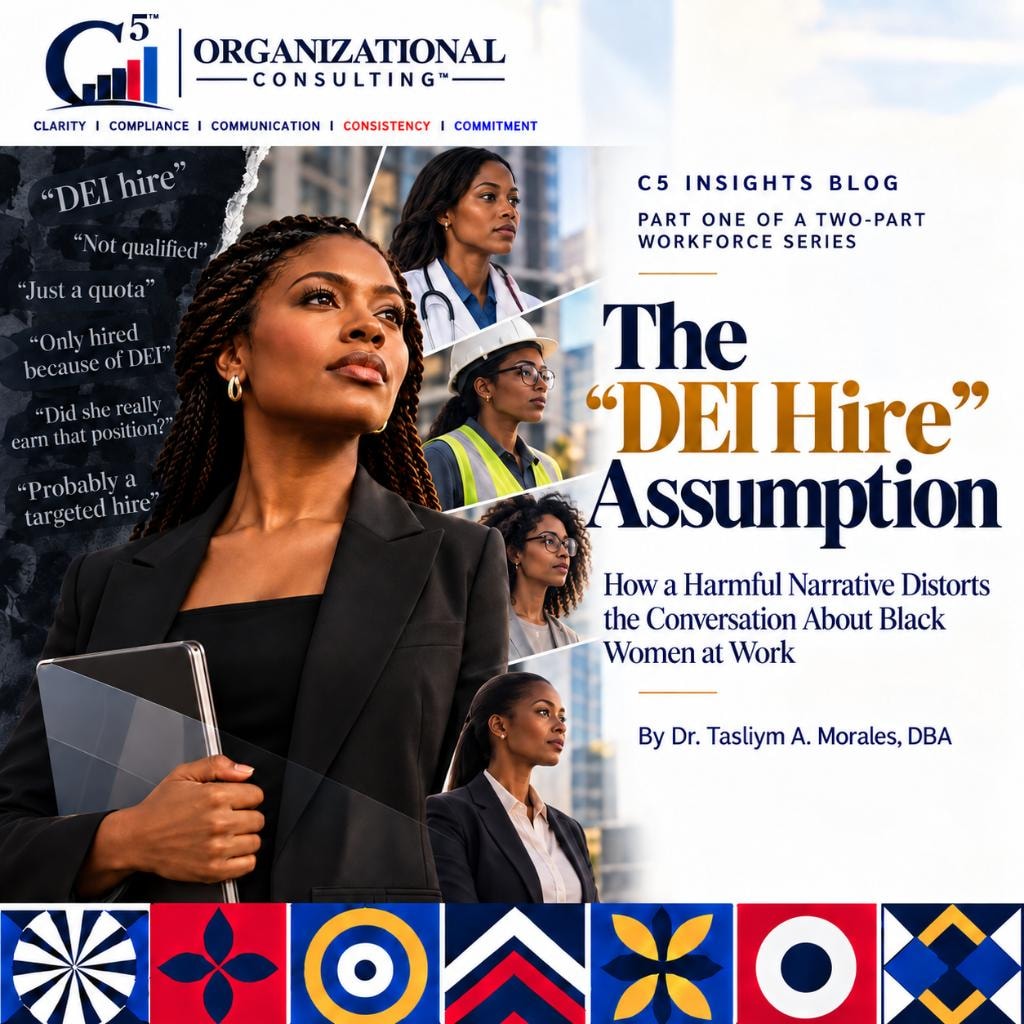
C5 Organizational Consulting™ | C5 Insights | Part One of a Two-Part Workforce Series
A Black woman earns an executive appointment, accepts a leadership role, or receives a promotion. Before her qualifications are discussed, someone questions whether she was a "DEI hire."
The question may be framed as skepticism about an employer's hiring practices, but its implication is directed at the woman herself: perhaps her race and gender explain her appointment more than her education, experience, or demonstrated ability.
This assumption has been amplified by voices that use DEI as a political and cultural criticism. Yet a troubling development occurs when the same premise begins to shape the language used to defend Black women. In trying to explain discrimination or the consequences of DEI rollbacks, we can unintentionally suggest that Black women's professional opportunities were dependent on DEI in the first place.
That is not a small distinction. It affects how Black women's qualifications are perceived, how their employment outcomes are explained, and whether we identify the actual workplace conditions that require attention.
We can defend equitable opportunity without diminishing the qualifications of the women who earned it.
The assumption begins before the evidence
The term "DEI hire" is often applied to a Black woman without any knowledge of the position's requirements, the applicant pool, the selection process, or her professional record.
It turns representation into supposed evidence of preference.
A Black woman may have the required education, years of relevant experience, a record of strong performance, and the competencies needed for a role. None of those facts can be dismissed simply because she belongs to a group that has historically faced barriers to employment or advancement.
Nor does an employer's commitment to diversity establish that a particular employee was selected through an unlawful preference. DEI can refer to many different practices, including broader recruitment, mentoring, accessibility, professional development, and reviews of workplace barriers. The legality of a specific employment practice depends on how it operates, not on its label.
The same standard of evidence should apply to every hiring decision. If there is a concern about an employer's selection process, examine the process. If there is a concern about a candidate's qualifications, examine the qualifications.
A Black woman's presence in a position is not, by itself, evidence that she received preferential treatment.
When the response begins to repeat the premise
There is a difficult part of this conversation that deserves attention, particularly within narratives intended to support Black women.
In response to attacks on DEI, some commentary has begun to connect Black women's professional success so closely to DEI initiatives that the distinction between access to opportunity and qualifications for opportunity becomes blurred.
The intention may be to defend programs that addressed longstanding barriers. It may also be to call attention to discrimination that persists in hiring, promotion, compensation, and retention.
Those concerns are legitimate. But when we describe Black women as having gained their positions because of DEI, we risk accepting the same assumption used to question whether they deserved those positions.
Consider the difference between two statements:
"An employer's recruitment and development programs helped ensure that qualified Black women had access to opportunities from which they may previously have been excluded."
"An employer set a target to hire 10 Black women as part of its DEI initiative."
The first statement describes an effort to expand access to opportunity. The second describes a race- and gender-specific hiring target. It raises questions about how the employer established that target and whether its selection practices complied with employment law. But it still does not establish why any particular woman was hired or whether she was qualified.
The problem arises when a stated organizational goal becomes the explanation for an individual's appointment. A Black woman's qualifications can disappear from the conversation, replaced by an assumption about the employer's intentions.
We should be able to scrutinize an employer's hiring practices without treating every Black woman it hires as evidence of those practices.
This distinction becomes even more consequential when discussing job losses. If we suggest that Black women are losing employment because DEI is being rolled back, without examining the positions, employers, and industries involved, we may inadvertently imply that DEI was the reason they were employed.
We should not have to accept a false premise about our success in order to explain a real concern about our opportunities.
This is not an argument that Black women created the stereotype. Nor is it a suggestion that discrimination has disappeared. It is an argument for greater precision in how we challenge both.
Why this narrative is harmful
The first harm is to professional credibility.
A Black woman who is presumed to be a DEI hire may be expected to repeatedly establish qualifications that others are allowed to demonstrate through their work. Her appointment becomes a subject of suspicion before her performance can be evaluated.
The second harm is to authority.
When colleagues or stakeholders believe a leader was selected for reasons unrelated to her qualifications, they may question her decisions through that assumption. A label attached at the point of hiring can continue to shape perceptions of her leadership long afterward.
The third harm is to the conversation about workplace fairness.
The "DEI hire" accusation shifts attention from the employer's actual practices to the identity of the employee. Instead of asking whether job requirements were relevant, interviews were consistent, promotion criteria were transparent, or development opportunities were accessible, the discussion becomes a debate over whether a Black woman belongs in the role.
The fourth harm is less obvious: the narrative can weaken our ability to explain what is happening to Black women in the current workforce.
When one explanation becomes the default, other explanations receive less attention — even when they are essential to understanding the problem.
The blind spot in the workforce conversation
Black women experienced substantial employment pressure in 2025. The Institute for Women's Policy Research reported a significant decline in estimated employment during the first eight months of the year, followed by a partial recovery. Its analysis also identified losses in federal employment.
Those findings deserve serious examination. But a decline in the number of employed Black women does not tell us that each woman was laid off, that she had been hired through a DEI initiative, or that a DEI rollback caused her employment to end.
We need to ask more specific questions.
Were positions eliminated through federal workforce reductions? Did private-sector employers restructure or slow hiring? Which industries lost jobs, and which added them? Were workers affected differently by occupation, seniority, geography, or type of employer? Did changes to recruitment and development programs alter access to future opportunities, even where existing jobs remained intact?
These questions are not alternatives to examining discrimination. They are part of examining it responsibly.
Black women are not employed in one industry, one type of role, or one level of an organization. A federal employee, a health care professional, a manufacturing worker, a nonprofit executive, and a recent graduate entering the workforce may all encounter different conditions.
If we explain their experiences through a single DEI narrative, we risk missing the differences that would help employers, researchers, and workers identify meaningful solutions.
We also need to examine the experiences of other workers. Changes affecting Black women should be considered alongside employment trends among Black men, White women and men, Hispanic workers, Asian workers, and other groups where reliable data are available.
That comparison is not intended to minimize Black women's experiences. It helps establish which changes are widespread, which are concentrated in particular industries, and which may reflect disparities requiring closer investigation.
A credible explanation must account for the evidence, including the evidence that complicates our assumptions.
Access to opportunity is not the same as a guarantee of employment
An effective recruitment initiative can expand the pool of qualified applicants. A mentoring program can make professional networks more accessible. A transparent promotion process can reduce the influence of informal relationships and inconsistent standards.
These practices may help an organization identify talent it previously overlooked.
They do not make the resulting employees less qualified.
At the same time, employers must ensure that hiring, promotion, compensation, and development decisions comply with applicable employment law. A program's stated commitment to equity does not excuse unlawful discrimination, just as the removal of a DEI label does not establish that an organization's practices are fair.
That is why the discussion should focus on what employers actually do.
Who learns about an opening? Which requirements are necessary for the work? How are candidates evaluated? Who receives developmental assignments? How are promotion decisions documented? Are the same standards applied consistently?
Those questions allow us to assess opportunity and fairness without making unsupported assumptions about the people who were hired.
Black women should not have to defend their qualifications through a policy debate
Black women should be able to acknowledge that barriers exist without having their achievements attributed to programs intended to address those barriers.
They should be able to support lawful efforts to expand opportunity without being expected to defend every initiative an employer calls DEI.
They should also be able to question the design or effectiveness of a DEI program without that position being interpreted as opposition to workplace fairness.
The point is not to deny that workplace policies matter. They do. Recruitment practices, professional networks, access to development, and consistent selection criteria can influence who receives an opportunity.
The point is that access to a fair opportunity and the qualifications to succeed in it are different things. We do Black women a disservice when we collapse them into one explanation.
The C5 perspective: Move from labels to evidence
At C5 Organizational Consulting™, our five foundational areas provide a practical framework for examining the workplace without relying on assumptions about individual employees.
Clarity: Define the employment practice under discussion. Are we examining recruitment, hiring, promotion, professional development, retention, or workforce reductions? Each requires different evidence.
Compliance: Assess whether employment decisions follow applicable law and documented, job-related criteria. Neither the presence nor the absence of a DEI label answers that question.
Communication: Explain how opportunities are advertised, how decisions are made, and how employees can raise concerns. Unclear processes create space for speculation and distrust.
Consistency: Determine whether the organization applies its stated standards across candidates, managers, departments, and employee groups.
Commitment: Review actual workforce outcomes. Where disparities appear, investigate them. Where practices create unnecessary barriers, address them. Where the evidence points to broader economic or industry changes, acknowledge those factors rather than forcing them into a preferred narrative.
These principles allow employers to examine fairness without reducing employees to demographic assumptions.
Before we examine the losses, we must correct the premise
The next article in this series will examine where Black women gained and lost employment, which industries experienced the greatest changes, and how those outcomes compare with other workers.
But that analysis must begin here.
Black women are not a workforce created by DEI. Their qualifications do not become questionable because an employer values diversity. And their employment losses cannot be accurately explained by DEI rollbacks alone.
We can recognize the importance of policies that address barriers while still examining whether those policies are lawful, effective, and consistently administered. We can acknowledge discrimination without presuming that every Black woman's appointment resulted from preferential treatment. And we can investigate workforce losses without implying that the women affected were employed only because of DEI.
The assumption that every Black woman is a DEI hire is harmful not only because it diminishes individual achievements. It also narrows the questions we ask when those same women face employment challenges.
Black women deserve an accurate account of both their accomplishments and the conditions affecting their careers. Defending equitable opportunity should never require us to diminish the qualifications of the women who earned it.